

By Manju Dawkins, MD — Dermatologist, co-founder of Thimble and mom of 2. Last reviewed June 2026.
If your child gets nervous about shots, you've probably been handed the advice already: just distract them. Bring bubbles. Have them take deep breaths. Promise a treat after.
But which of these actually works? And does any of it really make a difference in the moment?
After years in practice and two kids of my own, here's what I've learned about distraction — what genuinely helps, and what we tend to get wrong.
What the research says
Distraction isn't just a nice idea. Meta-analyses of childhood needle procedures have found that active distraction during a procedure measurably reduces a child's distress. It works because attention is a limited resource — giving the brain a competing task leaves less room to process pain and fear. The key word is active: distraction your child participates in, not a screen playing in the background.
First: why distraction works at all
Pain isn't just physical. It's processed in the brain, which means what's happening in your child's mind during a procedure directly affects how much they feel. Active distraction gives the brain a competing task — something to focus on other than anticipating pain.
The key word is active. Passive distraction — a screen playing in the background, a toy sitting on the table doesn't work nearly as well as distraction that requires your child to actually do something.
Bubbles
Blowing bubbles is one of the most reliable distraction tools for young children during procedures. It works on two levels: it requires focused breath control, which naturally regulates the nervous system, and it gives kids a concrete task to concentrate on in the exact moment the needle makes contact.
For toddlers and preschoolers especially, bubbles are hard to beat. They're cheap, portable, and require zero explanation. Bring them to every appointment.
Breath work
For older kids, roughly six and up, controlled breathing is remarkably effective and more age-appropriate than bubbles. The technique doesn't need to be complicated. Slow breath in for four counts, hold for two, out for four. Or ask them to blow out like they're blowing out birthday candles.
What makes this work isn't just the distraction, it's the physiological effect. Slow exhales activate the parasympathetic nervous system, which is the body's calm-down mechanism. You're not just giving them something to do. You're actually changing what their body is doing in that moment.
Practice it at home before the appointment. A child who already knows how to do it won't have to learn under pressure.
Bribery
I'm going to say something that might surprise you: bribery works, and there's nothing wrong with it.
A small reward waiting on the other side of a procedure gives a child something to move toward rather than something to run from. It reframes the experience from "something being done to me" to "something I'm getting through." That's not manipulation — that's motivation, and it's developmentally appropriate.
The one caveat: don't attach the reward to bravery or to not crying. "You get the treat if you're brave" puts the burden on the child to perform an emotion they may not be able to manage. Just make the treat unconditional. You showed up. You did it. That's enough.
What distraction can't do
Here's the part that often gets left out of these conversations.
Distraction manages fear. It doesn't manage pain.
If the physical sensation of the needle is the primary driver of your child's distress, and for many kids it is, distraction alone won't be enough. The two things work on different systems. Fear lives in the mind. Pain lives in the body. You need to address both.
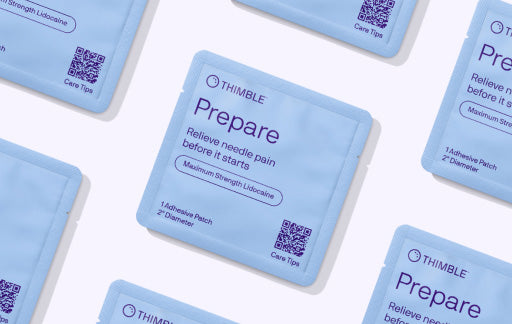
This is why I created Prepare, an over-the-counter numbing patch that takes effect in about an hour before a procedure. Applied ahead of time, it numbs the skin at the injection site so the physical sensation is dramatically reduced. Less pain means less fear, and less fear means distraction techniques actually have room to work.
The combination — numbing the site, active distraction during, a small reward after — is the most complete approach I know of. Each piece does something the others can't.
A note on staying calm yourself
Your child is reading you the entire time. Your nervous system talks to theirs before a single word is spoken. If you walk into that appointment braced for disaster, they feel it.
This isn't about performing calm you don't feel. It's about finding something genuine to hold onto — the fact that it will be over quickly, that you've prepared, that you're right there with them. Kids can tell the difference between performed reassurance and real steadiness. Aim for the second one.
The short version
Bubbles for little ones. Breath work for older kids. A treat waiting on the other side for everyone. Numbing the skin before you walk in the door. And your calm presence throughout.
None of this requires a perfect appointment. It just requires showing up prepared.
Manju Dawkins, MD is a board-certified dermatologist, mom of two, and the co-founder of Thimble. She created the Thimble Needle Care System after experiencing her daughter's first shots.
FAQ:
Does distraction actually reduce pain in kids during shots?
Active distraction — tasks that require focus like blowing bubbles or controlled breathing — has been shown to reduce distress in children during needle procedures. It works by competing for the brain's attention during the moment of the injection.
What age do distraction techniques work best?
Bubbles work well from toddler age onward. Breath work becomes more effective around age six when kids can follow instructions under pressure. Reward-based motivation works across almost all ages.
Is numbing better than distraction for kids?
They work on different things. Distraction reduces fear and anxiety. Numbing reduces physical pain. The most effective approach combines both — numbing the skin before the procedure and using active distraction during it.
How long before a shot should I apply a numbing patch?
The Prepare patch should be applied about one hour before the procedure for full effect. Apply it at home before you leave, so it's already working when you arrive.