

By Manju Dawkins, MD — Dermatologist, co-founder of Thimble and mom of 2. Last reviewed June 2026.
Most advice for getting kids through shots focuses on the fear. Stay calm. Bring a distraction. Use honest language. All of it helps, but none of it touches the actual physical sensation of the needle.
Just like you’d expect anesthesia for a surgery, our goal is that everyone receives pain management for a needle.
Does a numbing cream or patch really reduce needle pain?
Yes. Numbing the skin before a needle goes in measurably reduces the pain a child (or an adult) feels. It doesn't erase the sensation entirely and you or your child may still feel pressure, but it helps to take the sharp sting out of it.
This matters for more than one appointment. A lot of needle fear traces back to one early experience that hurt more than expected. Reducing the pain now can keep fear from taking root later.
What the research says
In a 2015 systematic review and meta-analysis of pain-reduction methods for injections, researchers found that numbing the skin with a topical anesthetic significantly reduced distress in children (across studies totaling more than 1,400 kids) and reduced self-reported pain in adults. An earlier meta-analysis of childhood immunization studies reached the same conclusion: across ten trials, children who had the skin numbed beforehand reported less pain than those who didn't. The evidence is consistent. Numbing the skin works.
How numbing the skin works
Topical anesthetics work by temporarily blocking the nerve signals in the top layers of skin. Applied to the skin ahead of time, it numbs the spot where the needle will go in.
How long before the shot should you apply it?
These products are not instant. They need time to absorb and take effect - depending on the product and the type of anesthetic between 30 minutes - 3 hours for maximum effectiveness. That means the best place to apply it is usually at home, before you leave for the appointment.
A few practical notes:
-
Apply it to the spot where the needle will go. For vaccines that's typically the upper arm in older kids, the thigh in babies. For blood draws it's usually the inner crook of the elbow. If you're not sure, ask ahead or consult our how tos here.
-
Give it the full recommended time if you can, but something is better than nothing. Pain is often emotional and psychological, in addition to physical.
Numbing creams vs. patches
Topical numbing comes two ways, and the difference matters more than people expect.
Numbing creams have to be measured out, applied in the right amount, often covered to keep them in place, and wiped off before the procedure. They can be messy, and it's easy to use too much or too little. Some, like the prescription cream EMLA, combine lidocaine with prilocaine and require a prescription. EMLA is effective and widely used, though prilocaine carries a rare risk of methemoglobinemia, which is why it's used with extra caution in infants. Prepare uses lidocaine alone, no prescription needed.
Numbing patches deliver a pre-measured dose in a fixed spot. You peel, place, and you're done. For a busy parent managing a nervous kid, that simplicity is the whole point. There's no guessing at the amount and nothing to wipe off the wrong way.
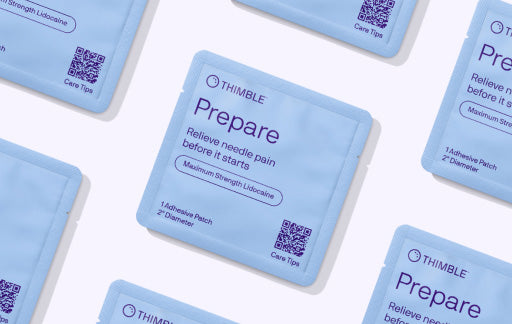
This is exactly why I created Prepare, an over-the-counter numbing patch with a pre-measured dose of 4% lidocaine, no prescription required. I wanted something a parent could use at home without the mess or the guesswork.
What numbing won't do
Numbing handles the physical pain. It doesn't handle fear.
You can have completely numb skin and still be scared, because fear lives in the mind, not the skin. That's why the most effective approach pairs numbing with the emotional tools: honest preparation, a distraction during the poke, a calm presence, a small reward after.
Numb the site. Reassure the mind. Together they change the entire experience. As you or the child trust that the process hurts less, they will fear less.
The bottom line
Numbing the skin genuinely reduces needle pain when it's applied early enough and in the right spot. Patches make it simpler and less messy than cream. And when you pair numbing with calm preparation, you're addressing both halves of what makes needles hard: the pain and the fear.
Dr. Manju Dawkins is a board-certified dermatologist, mom of two, and the founder of Thimble. She created the Thimble Needle Care System after experiencing her daughter’s first shots.
FAQ:
Do numbing creams or patches work work for shots?
Yes. Numbing the skin reduces the pain of vaccine injections when applied to the injection site about an hour beforehand. It reduces the sharp sting, though some pressure may still be felt. Remember pain is personal and often varies person to person. I can never promise that it won’t hurt at all, but it will help.
How long before a shot should you numb the skin?
Most topical numbing products, like Prepare, need about an hour to reach full effect, so applying at home before you leave for the appointment usually works best.
Is a numbing patch better than numbing cream for kids?
Both are good options, especially when supported by your physician. A patch delivers a pre-measured dose in a fixed spot with no mess and nothing to wipe off, which many parents find simpler than measuring and covering cream. Both reduce pain when applied early enough.
Does numbing work for blood draws too?
Yes. The same approach works for blood draws — apply to the usual draw site (often the inner elbow) about an hour ahead. Confirm the spot with your provider if you're unsure.