
By Manju Dawkins, MD — Dermatologist, co-founder of Thimble and mom of 2. Last reviewed July 2026.
Needles are one of the most common sources of procedural pain in healthcare. That may sound trivial, but it has important consequences. Needle fear leads people to delay blood work, avoid vaccinations, skip injectable medications, and postpone medical care they need.
If you've ever dreaded a shot, a blood draw, or an IV, you're not alone. Studies show that over 60% of adults report some level of needle fear,¹˒³ and about one in three people with needle fear have actually skipped a vaccination because of it.² Among children, the majority experience needle fear, and it's a leading reason families fall behind on immunizations.³
This isn't just about comfort. Needle fear is a real barrier to healthcare, and it's one we can solve.
"But don't numbing creams and patches only work on the surface?"
It's a great question.
Topical lidocaine, the numbing ingredient in the Thimble Prepare patch, penetrates only the top several millimeters of skin. Standard formulations typically reach a depth of about 3 to 5 mm.⁴
It doesn't directly numb the muscle where a vaccine is deposited or the deeper wall of a vein during an IV or blood draw.
So how can numbing only the top few millimeters meaningfully reduce pain from a needle that travels much deeper?
The answer lies in how we think about needle pain.
Many clinicians understandably assume that because an intramuscular vaccine or IV reaches deeper tissues, most of the discomfort must originate there. We now know the story is more complex. Every needle first passes through the skin, one of the most densely innervated organs in the body. Rather than serving as a passive barrier, the skin is an active sensory organ that plays a critical role in shaping the pain experience. Reducing pain at this first point of contact changes the total pain signal reaching the nervous system, even though the medication itself is delivered deeper.
This is where recent discoveries in pain science have fundamentally changed our understanding.
Your skin is not just a wrapper. It's a pain alarm system.
For decades, scientists viewed the skin primarily as a barrier, something a needle simply passed through on its way to deeper tissues. We now know that's incomplete. The skin itself is an active sensory organ.
In 2019, researchers discovered something remarkable: a mesh-like network of specialized cells (called Schwann cells) sitting just below the skin surface. This network functions as a previously unknown sensory organ: it detects painful stimuli and directly fires up pain nerve fibers.⁵ Think of it as a built-in alarm system woven through your skin.
On top of that, the outermost skin cells (called keratinocytes) can independently sense pain and send chemical signals to nerve endings. Three separate studies using advanced genetic techniques confirmed that activating these skin cells alone (without touching any nerve) is enough to trigger pain behavior.⁶
And here's the critical part: the nervous system and the immune system talk to each other right at the skin level. When a needle punctures the skin, pain nerves call in immune cells. Those immune cells release chemicals that make the nerves even more sensitive. The more sensitive nerves recruit more immune cells. It's a feedback loop, an amplification cascade, and it all starts at the surface.⁷
What this means for needle pain
A needle puncture doesn't just activate one nerve ending at one depth. It triggers a cascading chain reaction at the skin surface that amplifies the total pain signal sent to the brain and spinal cord.
The skin-level component of pain isn't a small, ignorable fraction. It's the ignition point for the entire pain experience.
This concept is also consistent with gate control theory, one of the foundational models of pain perception, which proposes that signals arising in the skin influence how pain is processed by the spinal cord.
Why topical lidocaine works, even for deeper procedures
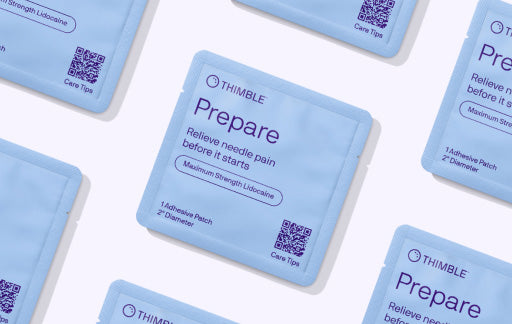
The Thimble Prepare patch delivers lidocaine to numb the skin before the needle pokes. By numbing those critical top millimeters, it may:
-
Reduce activation of the Schwann cell network involved in pain sensation
-
Decrease keratinocyte-mediated signaling to nearby nociceptors
-
Reduce the neuroimmune signaling that amplifies pain after tissue injury
-
Decrease the total pain input reaching the spinal cord, where skin and deep tissue signals converge
In short: it turns off the alarm system before the alarm goes off.
Why the Thimble Recover patch matters too
Pain doesn't end when the needle comes out.
Soreness, aching, and bruising can linger for hours or even days, especially after vaccinations and intramuscular injections. That lingering discomfort feeds into the memory of the experience and can increase fear of future procedures.
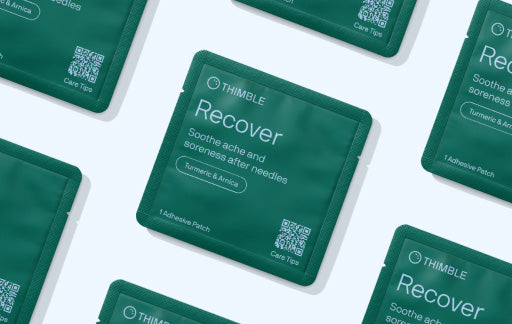
The Thimble Recover patch, with turmeric and arnica, is designed to soothe this post-procedure discomfort. By addressing both the acute pain (before) and the lingering soreness (after), the Thimble system treats the full arc of the needle experience, not just one moment of it.
The mind matters too
Pain isn't just physical. It's deeply influenced by anxiety, expectation, and past experience. Research shows that highly anxious patients report significantly higher pain scores from the same procedure. Systematic reviews of psychological interventions for needle procedures have found that distraction, breathing techniques, and cognitive-behavioral strategies all produce meaningful reductions in pain and distress.¹⁰
This is why the Thimble approach includes psychological comfort techniques alongside the patches. When you combine surface numbing, post-procedure soothing, and psychological support, you're addressing pain through every channel it travels: physical, chemical, and emotional.
Can reducing pain actually help treatments work better?
Emerging evidence suggests yes. Multiple studies and a meta-analysis have found that psychological stress is associated with weaker antibody responses to vaccination.¹⁴˒¹⁵ Chronic stress suppresses immune function through elevated cortisol and altered immune cell activity. A systematic review in children found that most studies suggest a negative role of stress on vaccine responses.¹⁶
Although no study has directly examined whether reducing needle pain improves vaccine effectiveness, there are plausible biological mechanisms linking pain, stress, and immune function. Several studies have shown that psychological stress is associated with weaker antibody responses to vaccination, raising the intriguing possibility that improving the vaccination experience could have benefits beyond comfort. This remains an important area for future research.
The bottom line
Topical lidocaine penetrates only a few millimeters, but the science shows that those few millimeters are where the pain cascade begins. Silencing the skin's alarm system before the needle arrives reduces the total pain experience from the entire procedure, not just the surface prick.
The Thimble Needle Care System (Prepare patch before, Recover patch after, combined with psychological comfort techniques) addresses needle pain through every pathway it travels. The clinical evidence across multiple randomized trials and meta-analyses consistently demonstrates significant pain reduction for procedures that go well beyond the depth of drug penetration.⁹˒¹⁰˒¹¹˒¹²˒¹³
As our understanding of pain biology continues to evolve, it's becoming increasingly clear that the skin is not simply where needle pain begins. It is an active participant in shaping the entire pain experience.
Frequently asked questions
Does numbing cream only work on the surface of the skin?
Topical lidocaine numbs the top few millimeters of skin, roughly 3–5 mm. But research shows those top millimeters are where the pain response begins, so numbing the surface reduces the total pain signal from the whole procedure, not just the surface prick.
Does lidocaine work for shots that go into the muscle?
Even though lidocaine doesn't reach the muscle directly, the skin surface is the ignition point of the pain cascade. Reducing pain signaling from the skin lessens how much total pain reaches the spinal cord, which lessens the deeper component too. Clinical trials consistently show meaningful pain reduction for injections that go deeper than the numbing.
How deep does topical lidocaine penetrate?
Standard topical lidocaine reaches about 3 to 5 millimeters into the skin.
If the needle goes deeper than the numbing, how does it still reduce pain?
Because the skin contributes much more to needle pain than we once appreciated. A needle puncture sets off a cascade of signaling at the skin surface that amplifies the overall pain response. Reducing that initial signaling decreases the total pain experienced, even though the needle extends.
References
-
Alsbrooks K, Hoerauf K. Prevalence, Causes, Impacts, and Management of Needle Phobia: An International Survey of a General Adult Population. PLoS One. 2022. View on PubMed
-
Taddio A, Ipp M, Thivakaran S, et al. Survey of the Prevalence of Immunization Non-Compliance Due to Needle Fears in Children and Adults. Vaccine. 2012;30(32):4807-4812. View on PubMed
-
McLenon J, Rogers MAM. The Fear of Needles: A Systematic Review and Meta-Analysis. J Adv Nurs. 2019;75(1):30-42. View on PubMed
-
Henkel ED, Haller CN, Diaz LZ, et al. Optimizing Pediatric Periprocedural Pain Management Part I — Evolving Ethics and Topical Anesthetics. Pediatr Dermatol. 2023. View on PubMed
-
Abdo H, Calvo-Enrique L, Lopez JM, et al. Specialized Cutaneous Schwann Cells Initiate Pain Sensation. Science. 2019;365(6454):695-699. View on PubMed
-
Talagas M, Lebonvallet N, Berthod F, Misery L. Cutaneous Nociception: Role of Keratinocytes. Exp Dermatol. 2019;28(12):1466-1469. View on PubMed
-
Lowy DB, Makker PGS, Moalem-Taylor G. Cutaneous Neuroimmune Interactions in Peripheral Neuropathic Pain States. Front Immunol. 2021;12:660203. View on PubMed
-
Sessle BJ. Fifty Years of Development of Neuroscientific Insights into Oro-Facial Pain and Its Control. J Oral Rehabil. 2023. View on PubMed
-
Patel BK, Wendlandt BN, Wolfe KS, et al. Comparison of Two Lidocaine Administration Techniques on Perceived Pain From Bedside Procedures: A Randomized Clinical Trial. Chest. 2018;154(4):773-780. View on PubMed
-
Shah V, Taddio A, McMurtry CM, et al. Pharmacological and Combined Interventions to Reduce Vaccine Injection Pain in Children and Adults: Systematic Review and Meta-Analysis. Clin J Pain. 2015;31(10 Suppl):S38-S63. View on PubMed
-
Pop CF, Coblișan P, Sas V, Drugă C, Cherecheș-Panța P. Local Lidocaine-Prilocaine for Immunisation in Infants. Vaccines (Basel). 2024. View on PubMed
-
Kartufan FF. Padded Dressing with Lidocaine HCL for Reducing Pain During Intravenous Cannulation in Adult Patients: A Randomized Controlled Clinical Trial. Biomed Res Int. 2022. View on PubMed
-
Maruszak A, Romańczuk D, Lange S, et al. Local Pharmacological Interventions for Pain Relief During Peripheral Venous Cannulation: A Systematic Review With Implications for Clinical Nursing Practice. J Clin Med. 2026. View on PubMed
-
Pedersen AF, Zachariae R, Bovbjerg DH. Psychological Stress and Antibody Response to Influenza Vaccination: A Meta-Analysis. Brain Behav Immun. 2009;23(4):427-433. View on PubMed
-
Ballesio A, Zagaria A, Violani C, Lombardo C. Psychosocial and Behavioural Predictors of Immune Response to Influenza Vaccination: A Systematic Review and Meta-Analysis. Health Psychol Rev. 2024. View on PubMed
-
Svensson R, Malon M, Stensballe LG, Thorsen SU, Svensson J. The Effect of Stress on the Antibody Response After Vaccination in Children Aged 0-18 Years: A Systematic Review. Scand J Immunol. 2024. View on PubMed