

This past weekend, our co-founder Manju Dawkins, MD had the honor of speaking at the MAGIC Foundation Convention, to a room full of families who know needles better than most. For children managing growth and hormone conditions, injections and blood draws aren't a once-a-year event. They're a daily or weekly part of life. And the families in that room are, as Dr. Dawkins put it, already the experts.
Her talk was about something Thimble was built on: that every needle experience matters, and that the pain and fear are worth taking seriously, for the child and for the parent.
The daily weight
For a family managing a chronic condition, the needle is only part of it. There are the clinic visits and blood draws, the insurance to navigate, the medications to track, the daily or weekly injections. It adds up, and it lands on both the child and the caregiver. Dr. Dawkins opened by naming that weight honestly, because you can't address needle pain without acknowledging everything around it.
Why the fear is worth addressing
This isn't only about comfort. Research from the University of Oxford found that if injection anxiety were removed, a meaningful share of vaccine hesitancy might disappear with it, and that avoidance of needles keeps people from blood draws, donations, and care they need. The World Health Organization has named pain mitigation an important strategy in its own right. Unaddressed pain shapes how people feel about healthcare for the rest of their lives. For a child who faces needles regularly, those early experiences matter enormously.
Children borrow our nervous systems
One of the most powerful ideas in the talk was also the simplest: co-regulation. When a parent calms their own nervous system, they help their child calm theirs. Kids read the adults around them to decide whether a moment is safe. So a parent's steadiness isn't a small thing, it's one of the most effective tools there is.
Before, during, and after
Dr. Dawkins walked through practical, evidence-based ways to ease the experience at every stage:
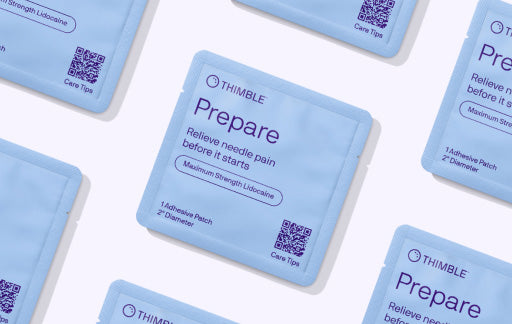
Before: Numbing the skin ahead of time, letting injectable medications reach room temperature if appropriate, rotating injection sites, and giving children a sense of control by offering choices (which arm, which bandage, music or bubbles). She reviewed the range of tools available, from our own numbing patch to ice, numbing creams, and others, so families can find what works for them.
During: Comfort positioning instead of restraint (upright, comforting holds that help a child feel secure), active distraction like bubbles or slow breathing, and keeping the injection site relaxed.
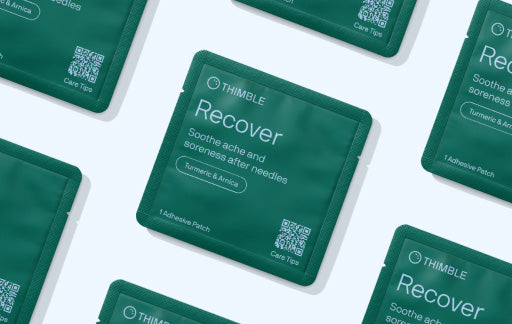
After: Gentle movement and hydration, managing soreness with ice or heat, and soothing patches for the tenderness that can linger.
For families who want the step-by-step versions, our free guides walk through many of these.
The greatest pain reliever
Dr. Dawkins closed on the truest note of all: for a child facing a needle, a parent's love and presence is the greatest pain reliever there is. The tools help. The science helps. But the steady, loving adult holding their hand is what a child remembers.
Thank you to the MAGIC Foundation and to every family in that room. You're doing something genuinely hard, every day, and it's a privilege to support you in it.
Manju Dawkins, MD is a board-certified dermatologist, mom of two, and the co-founder of Thimble. She created the Thimble Needle Care System after experiencing her own daughter's first shots.
--------------------------------------------------------------------------------------
Reference
Freeman D, Lambe S, Yu LM, et al. Injection fears and COVID-19 vaccine hesitancy. Psychological Medicine. 2023;53(4):1185-1195.
https://pubmed.ncbi.nlm.nih.gov/34112276/