

"It's quick." "It's just a pinch." "It'll be over before you know it."
Those sentences get said in exam rooms thousands of times a day, almost always kindly, and they are the single biggest reason needle pain goes unmanaged. If it's trivial, then treating it is fussy. If it's over in a second, then anyone who wants to do something about it is making a fuss.
I’ve seen the impact of needle fear with my patients, with my family, and what I've watched, over and over, is that the needle isn't the part that lingers. What lingers is what the person learned. A four-year-old who gets surprised by a needle learns something about exam rooms and carries it. Adults who dread blood draws are usually not being dramatic. They're remembering pain.
That's what the pinch framing misses. It isn't about a bad thirty seconds. It's about whether someone shows up for the next appointment, and the one after that.
Very few researchers have spent a career on this. Anna Taddio has. She's a professor at the University of Toronto and a scientist at the Hospital for Sick Children, and she led the Canadian clinical practice guideline on reducing pain during vaccine injections that came out in 2015 and shaped how a lot of clinicians, including me, think about this. When her name is on a paper in this area, I stop what I'm doing and read it.
Her team has just published the ten-year update. Taddio herself stepped back from the voting on it, because her own research overlapped with what was being evaluated, which tells you something about how the group operates.
Part of that update is a new systematic review and meta-analysis in the Clinical Journal of Pain. It gathers 71 studies and ranks every intervention applied to the injection site itself against each other. Not opinion. Not one trial. Everything, sorted.
Numbing the skin came out at the top of the list. For infants, and for everyone older.
Here's what it found, what it doesn't prove, and what I'd do with it.
What this research is
A systematic review and meta-analysis means a team gathered every randomized trial they could find on a question, assessed the quality of each one, and pooled the results. It's the closest thing we have to a summary of what's actually known.
The team searched five research databases, used GRADE and Cochrane methods, and had at least two reviewers read every study. They ran separate analyses for infants under twelve months and for everyone older, because a two-month-old and a forty-year-old are not the same problem.
Seventy-one studies made the cut.
What they found
For infants, topical numbing and manual tapping came out as the preferred options. After those: pressure applied by hand or by a device, cold or ice, or a vibrating device used together with cold. Then a vapocoolant spray. Then vibration without cold. Rubbing the skin didn't have enough evidence behind it to say much.
For everyone over twelve months, topical numbing was first. Manual tapping came next. Then vibration, with or without cold. Pressure, cold or ice, and vapocoolants were less preferred. Rubbing was again the weakest of the group.
Put the two lists side by side and the same two things sit at the top of both: numbing the skin, and tapping it.
One more detail worth knowing. Researchers use a threshold to decide whether an effect is large enough to actually matter to a person, rather than just being statistically detectable. In this review, nearly every analysis cleared that threshold. These aren't rounding errors.
Three things I keep thinking about
It held up across the entire lifespan. Most research on needle pain has been done in children, and there's a quiet assumption underneath it that adults should just handle it. This review analyzed adults and older kids as their own group, and topical numbing was still the top-ranked option. If you're doing fertility injections, or weekly shots for a chronic condition, or you're the parent who's been white-knuckling your own blood draws for twenty years, that finding is about you.
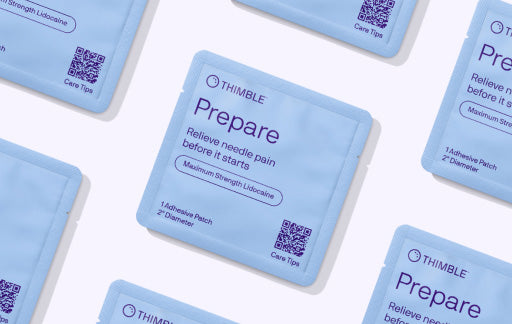
Tapping is free. I want to say this plainly, because I sell a numbing patch and I'd rather be useful than convenient. Manual tapping placed at or near the top of both lists and it costs nothing. You tap the skin near where the needle is going. That's it. If you do one thing after reading this, do that.
"Preferred" is a ranking, not a promise. The review sorted options against each other. It did not find something that makes needles stop hurting. Nothing does. What it found is that some things help more reliably than others, and the ones near the top are worth reaching for first.
What this research doesn't say
You should be more suspicious of health content that only tells you the good part, so here's the other half.
It looked at a category, not a product. "Topical anesthesia" covers prescription creams, patches, and formulations tested over decades in research settings. This review didn't test our patch, or any other specific brand. It tells you the approach has evidence behind it. It doesn't tell you any one product performs the way the pooled data does.
The certainty varied a lot. The authors rated confidence in each finding on a scale running from high to very low, and the range here ran the whole way. Some conclusions rest on solid ground. Some rest on a handful of small trials. That's the honest state of the evidence, not a flaw in the review.
It measured distress during the injection. Not the arm that aches the next morning. That's a different question with a different set of answers, and I wrote about the sore arm after a shot separately.
It isn't about whether to get vaccinated. These studies were conducted in vaccine settings because that's where most needle procedures happen. The findings are about making a needle hurt less. What you choose to put in your body is between you and your doctor, and I'm not in that conversation.
What I'd actually do with this
If there's a needle coming, stack a few of these rather than picking one.
Numb the skin, and give it time. This is the part people get wrong most often. Topical anesthetics need time to work, generally something in the range of an hour, and a product applied in the parking lot won't do what a product applied before you left the house does. If you're using a numbing patch, read the timing instructions once, properly, the day before.
Tap the skin nearby. Before and during. It costs nothing and it ranked near the top for every age group.
Skip the rubbing. It's the one most of us do instinctively and it's the one with the least behind it.
Don't drop the rest of it. Numbing the skin handles the physical part. It doesn't touch the anticipation, which for a lot of people is the harder half. Preparation, giving a kid a small choice, having something to focus on: all of that still matters. I've written more about what helps before a shot if you want the fuller picture.
Questions I've been asked about this
Does numbing cream affect how well a vaccine works?
This is the question I get most, and it's a fair one. Studies going back to the early 2000s looked specifically at whether lidocaine-prilocaine patches interfered with antibody response to childhood vaccines, and they did not find that effect. If you have any concern about your own situation, ask whoever is giving the injection. They will not think it's a strange question.
How long before the appointment should I apply something?
Follow the instructions on whatever you're using, and build in more time than you think you need. Not allowing enough time is the most common reason people conclude a numbing product "didn't work."
Is tapping really as good as numbing?
In this review, tapping placed at or near the top for both age groups, alongside topical numbing. They work differently, so there's no reason to choose. Do both.
Does any of this work for adults, or just kids?
The review analyzed adults and older children as their own group, and topical numbing was the top-ranked option there too.
The short version
Needle pain is real, it's measurable, and there is now a decade-deep evidence base on what reduces it. The people who built that evidence base did it because they understood that this is never only about the pinch. It's about what someone learns to expect from healthcare.
So you're not being dramatic for wanting to do something about it. You're doing what the research says to do.
Written by Manju Dawkins, MD, board-certified dermatologist and co-founder of Thimble. This article is for general information and isn't a substitute for advice from your own clinician.
References
-
A Systematic Review and Meta-Analysis of Pharmacological and Physical Interventions Directed at the Injection Site for Reducing Distress During Vaccine Injections. Clinical Journal of Pain. 2026;42(8):e1374. doi:10.1097/AJP.0000000000001374
-
Taddio A, McMurtry CM, Shah V, et al. Reducing pain during vaccine injections: clinical practice guideline. CMAJ. 2015;187(13):975-982. PubMed
-
HELPinKids&Adults 2026 Guideline Update on Reducing Distress During Vaccine Injections: Overview of Methods and the Evidence Base. Clinical Journal of Pain. 2026;42(8S Suppl 1):e1375. PubMed
-
Halperin BA, Halperin SA, McGrath P, et al. Use of lidocaine-prilocaine patch to decrease intramuscular injection pain does not adversely affect the antibody response to diphtheria-tetanus-acellular pertussis-inactivated poliovirus-Haemophilus influenzae type b conjugate and hepatitis B vaccines in infants. Pediatr Infect Dis J. 2002;21(5):399-405. PubMed